
English
English
Views: 0 Author: Site Editor Publish Time: 2026-02-06 Origin: Site


In the world of industrial motor drives, achieving energy efficiency and extending equipment lifespan hinges on two technologies: Variable Frequency Drives (VFD) and Soft Starters. At the heart of these systems lies a critical component—the Thyristor Module. The precision of its conduction angle control directly determines the smoothness of motor startup, current accuracy, and overall system reliability.
The conduction angle ($\theta$) of a Thyristor Module refers to the electrical angle during which the device remains in a conducting state within an AC cycle.
The Mechanism: By dynamically adjusting the control angle ($\alpha$), engineers can precisely regulate the duration of current flow in each voltage half-wave.
The Benefit: This electronic regulation offers rapid response times and zero mechanical wear, making it superior to traditional mechanical switching for modern industrial automation.
During the startup phase, motors often face a massive inrush current—typically 5 to 7 times the rated current. This can cause grid instability and mechanical shock.
A high-quality Thyristor Module mitigates this through a "Ramp-up Voltage" strategy:
Initial Phase: The system starts with a large $\alpha$ value (small conduction angle $\theta$), allowing the motor voltage to rise slowly from zero.
Smooth Acceleration: As speed increases, the module gradually increases $\theta$, ensuring the starting current remains within 2 to 3 times the rated value.
Closed-Loop Safety: Advanced modules monitor motor current in real-time, dynamically balancing the conduction angle to ensure a safe and rapid start.
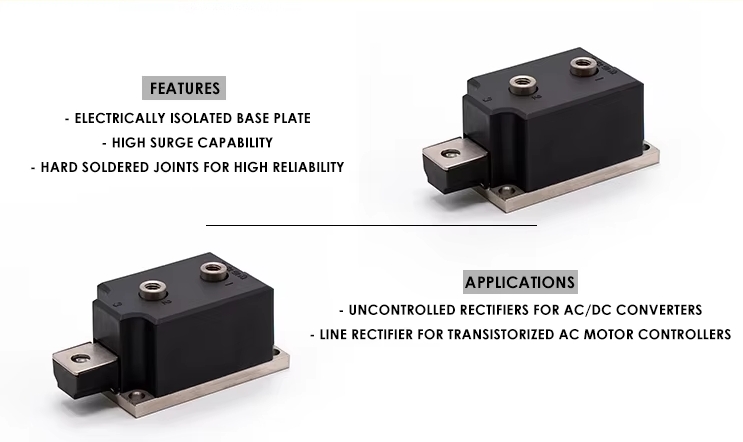
In Variable Frequency Drives (VFD), the Thyristor Module works in tandem with the inverter unit to manage power conversion.
Rectification: The module converts AC to adjustable DC, providing a stable voltage source for the next stage.
PWM Integration: By combining conduction angle control with Pulse Width Modulation (PWM), these modules can adjust voltage within microseconds. This ensures the motor maintains constant torque output even at low frequencies, meeting the demands of heavy-load startups.
While Thyristor Modules are powerful, they face challenges like harmonic pollution and heat dissipation during high-frequency adjustments.
As a professional manufacturer, we focus on cutting-edge solutions to these issues:
Advanced Materials: Incorporating next-gen semiconductors to reduce losses.
Smart Cooling: Integrated intelligent heat dissipation systems to handle high-load operations.
Optimized Algorithms: Refined trigger pulse algorithms to minimize grid interference.
As we move toward Industry 4.0, the role of the Thyristor Module in conduction angle control continues to evolve toward higher precision and lower losses. For businesses looking to optimize their motor drive systems, choosing a reliable module is the first step toward efficient power management.
