
English
English
Views: 0 Author: Site Editor Publish Time: 2025-11-04 Origin: Site


If you've ever check an SCR datasheet and felt lost among all the strange letters and numbers like IT(AV)or Vtm@It&Tj, you're not alone.
These symbols come from a long tradition in semiconductor standards — and once you know what each letter stands for, everything starts to make sense.
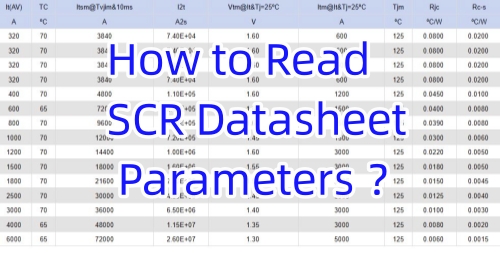
Let's decode the most common ones you'll see for Thyristors (SCRs) and Diodes.
If you prefer a quicker, more direct overview of what each parameter means, feel free to jump straight to the summary table — we’ve organized all the key SCR datasheet symbols in one place for easy reference.
— we've organized all the key SCR datasheet symbols in one place for easy reference.
I = current (from “intensity of current”)
T = “through-state” or “thyristor”
AV = average
This tells you how much current the SCR can carry continuously while it’s turned on.If your circuit draws 300A, choose a device rated for at least 400A to leave room for heat and overloads.
T = temperature
C = case
This is the external housing temperature used for measurement.It's like saying, “we tested it at 70°C.” If your cooling system is weaker, choose a higher-rated SCR.
I = current
T = thyristor
SM = surge maximum
This is the maximum one-time current spike the SCR can survive — for example, when you switch on a motor or welding transformer.
I² = current squared
t = time
This measures how much energy the device can handle during a short surge.You’ll see this used when engineers pair SCRs with fuses. The higher the number, the stronger the device under short-circuit conditions.
V = voltage
T = through-state
M = maximum
When the SCR is ON, this is how much voltage it “uses up” internally.Lower VTM means less heat loss and higher efficiency.
T = temperature
J = junction (the semiconductor chip)
M = maximum
Think of it as the safe heat limit for the silicon chip inside.If the junction goes above this temperature (usually 125°C–150°C), the device can fail permanently.
R = resistance
jc = junction to case
It shows how well heat travels from the chip to the case.A lower number = better heat transfer, which means the SCR can run cooler.
R = resistance
c-s = case to heatsink
This measures the efficiency of your mounting and cooling.
Good thermal grease or pressure contact can reduce this value and improve performance.
◆ Now that you understand what each parameter really stands for, here's a quick reference table to help you review and double-check your understanding at a glance.
| Parameter | Full Name | Meaning in Simple Terms | Why It Matters When Choosing |
|---|---|---|---|
| It(AV) | Average On-State Current | The average current the SCR can carry continuously when it’s ON. | Choose this value higher than your equipment’s working current (add ~20–30% margin). |
| Tc | Case Temperature | The temperature of the SCR’s outer metal case during testing. | Real devices get hotter — good cooling keeps Tc close to rated value. |
| Itsm | Surge Peak Current | The maximum short-time current (for 10 ms) the SCR can safely handle. | Important for loads with current spikes — e.g., welding, motor start. |
| I²t | Energy Rating | The energy (current² × time) the device can absorb in a short surge. | Helps match with fuses or protection devices — higher means stronger surge tolerance. |
| Vtm | On-State Voltage Drop | The voltage across the SCR when it’s conducting at rated current. | Lower Vtm = less power loss and heat generation. |
| Tjm | Maximum Junction Temperature | The highest safe temperature of the silicon chip inside the SCR. | Keep below this limit for long device life (usually 125 °C–150 °C). |
| Rjc | Thermal Resistance (Junction → Case) | How easily heat moves from the chip to the case. | Lower Rjc = better heat transfer = cooler and more reliable. |
| Rc-s | Thermal Resistance (Case → Sink) | The heat path between the case and the heatsink. | Depends on mounting and grease — smaller Rc-s improves cooling. |
Once you understand the “language” of datasheets, you can easily spot:
How much current the SCR can handle continuously? (It(AV))
How much surge it can survive ?(ITSM, I²t)
How efficiently it runs? (VTM, Rjc)
How to design for reliable cooling ?(TC, Rc-s)
These parameters aren’t random numbers — they tell you how long your SCR will last and how well it will perform in your system.
Whenever you see something like “@ It & Tj = 25 °C”, it simply means:
The measurement was made at that current (It) and that junction temperature (25 °C) —
a standard laboratory condition for comparing SCR performance.
In short, they tell you the exact test conditions under which the manufacturer measured that parameter.
Electronics behave differently depending on temperature, current, and pulse duration, so these symbols make sure everyone is comparing under the same conditions.
✅Example 1: “Vtm @ It & Tj = 25°C”
This means the on-state voltage drop (Vtm) was measured when:
The SCR was conducting its rated current (It)
The junction temperature (Tj) — that’s the internal silicon chip temperature — was 25°C
In other words, it's the voltage drop under standard room temperature conditions.
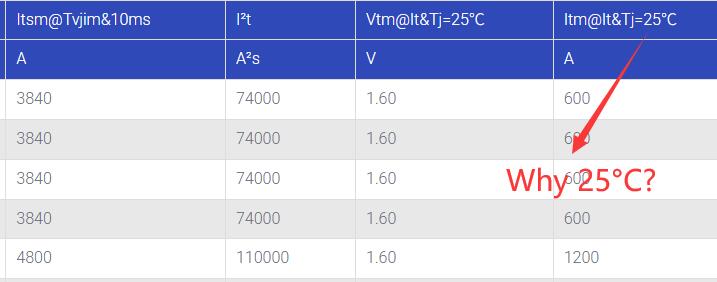
Because it’s the industry reference temperature, used as a baseline so that all manufacturers test under the same point.
At higher operating temperatures, the voltage drop will be slightly higher — so in real applications, your SCR may run a little warmer than this lab number.
These “@” conditions are not extra details — they are your context clues.They tell you when and how the data applies.
If your operating environment is hotter than 25°C, or your current pulses last longer than 10ms, you may need a higher-rated device.
⚙️Tip from PowerPassion Electric
When choosing an SCR or diode module, never rely on current alone.
Check the thermal resistance, surge rating, and trigger sensitivity — that's what separates a reliable power device from one that fails under stress.
If you're not sure how these parameters fit your system —
don't worry about calculating everything by yourself.
Contact our technical sales team can help you match the right current, voltage, and surge ratings for your real-world conditions.

Just tell us your working current, voltage, and duty cycle — we'll recommend the proper SCR or module model for you.


